


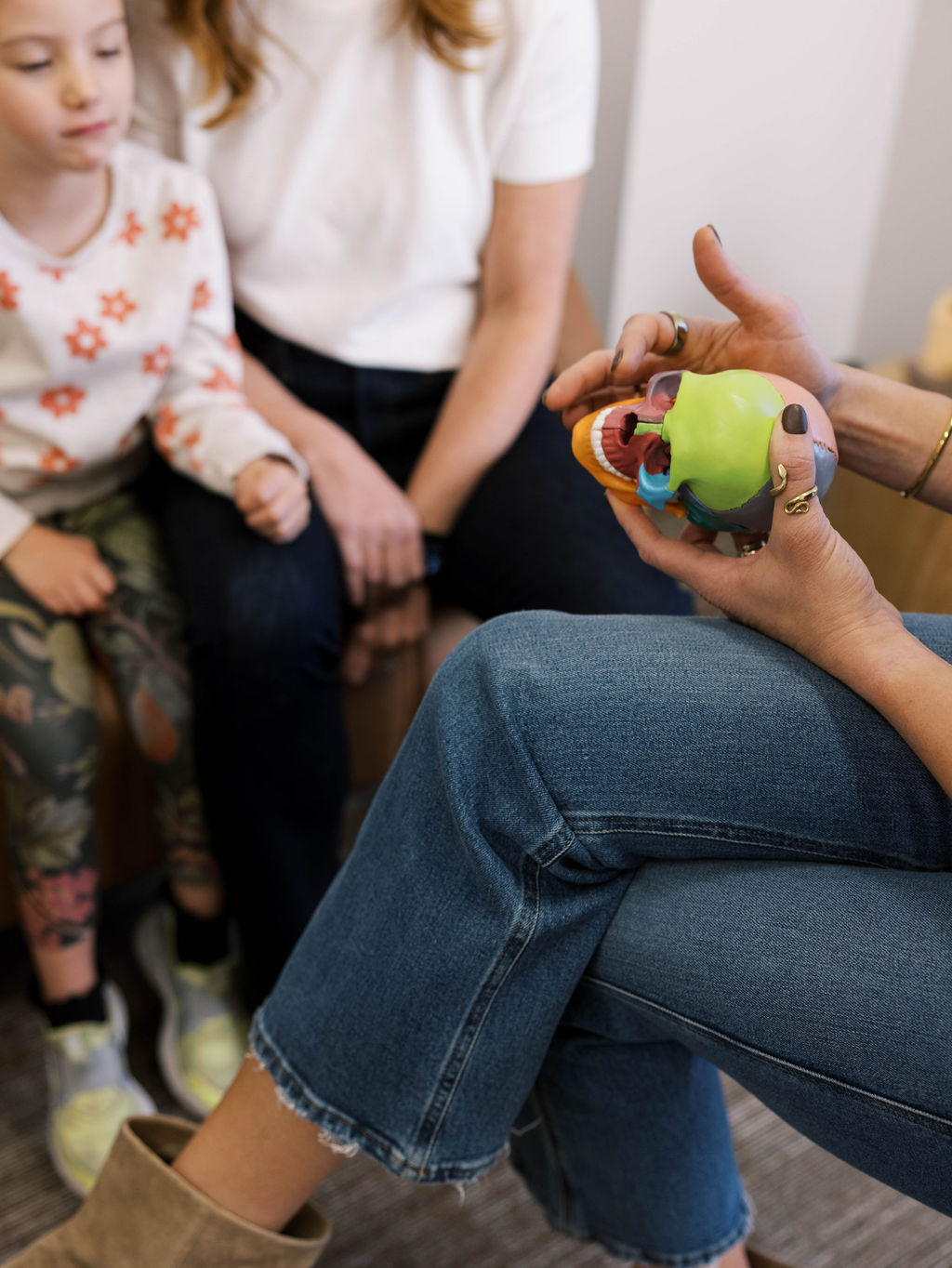

You went through the consult. You scheduled the release. You did the stretches for two weeks. And then someone — maybe us, maybe another provider — said, “now therapy.”
Wait, therapy? Isn’t the release the fix?
Not quite. And this is where a lot of families get stuck.
Releasing a tongue tie restores the range of motion. It doesn’t automatically teach the tongue what to do with that new range. That’s what myofunctional therapy is for. This guide walks Lakewood parents through children’s myofunctional therapy after tongue tie Lakewood Colorado families rely on to lock in long-term results — what it is, what sessions look like, and how to fit it into a school week.
Most general dentists don’t offer this step. That’s often why results disappoint. Our Lakewood office is close to Green Mountain, Bear Creek, and the central neighborhoods, and therapy sessions are built around school schedules.
Myofunctional Therapy Teaches the Tongue to Live at the Roof of the Mouth
The tongue is a muscle. It needs training like any other muscle.
Think of it this way: if your child broke their arm, the cast would come off eventually — but they’d still need physical therapy to get their strength and range back. The release is the cast coming off. Therapy is the rebuild.
Correct oral rest posture looks like:
- Tongue gently suctioned to the roof of the mouth
- Lips closed, at rest
- Teeth slightly apart, not clenched
- Breathing quietly through the nose
The American Speech-Language-Hearing Association’s resource on orofacial myofunctional disorders describes nasal breathing with the tongue on the palate as essential to proper craniofacial growth and oral function. This is the posture therapy is building toward.
Therapy uses short, specific exercises to train four things: swallow pattern, lip seal, chewing mechanics, and tongue strength. Many Green Mountain and Bear Creek parents appreciate that the exercises travel well — kids can practice on a walk along Bear Creek Trail, in the car, or during a show.
It’s less “appointment” and more “new habit.”
Without Therapy, the Tongue Often Returns to Its Old Position
This is the part most practices don’t talk about honestly.
Muscle memory is real. Your child’s tongue has been resting low for their whole life. Without new patterns, that’s where it goes back to — even after the release opens up the range of motion.
What can fade without therapy:
- Nasal breathing can slip back toward mouth breathing
- Tongue drops back to the floor of the mouth
- Palate development stalls
- Snoring and restless sleep creep back in
- Facial growth and airway support don’t get the boost they could
Parents who skip therapy often report the same story: “It worked for a while, then it didn’t.” That’s not the release failing. That’s the old pattern winning because nothing new was built to replace it.
The American Academy of Pediatric Dentistry’s policy on frenulum management frames post-procedure support as part of a coordinated approach — not an optional add-on. For kids already in traditional orthodontics, therapy often speeds progress because the tongue stops fighting the appliances.
Therapy is what turns a procedure into a long-term change.
Sessions Are Short, Playful, and Built for Children’s Attention Spans
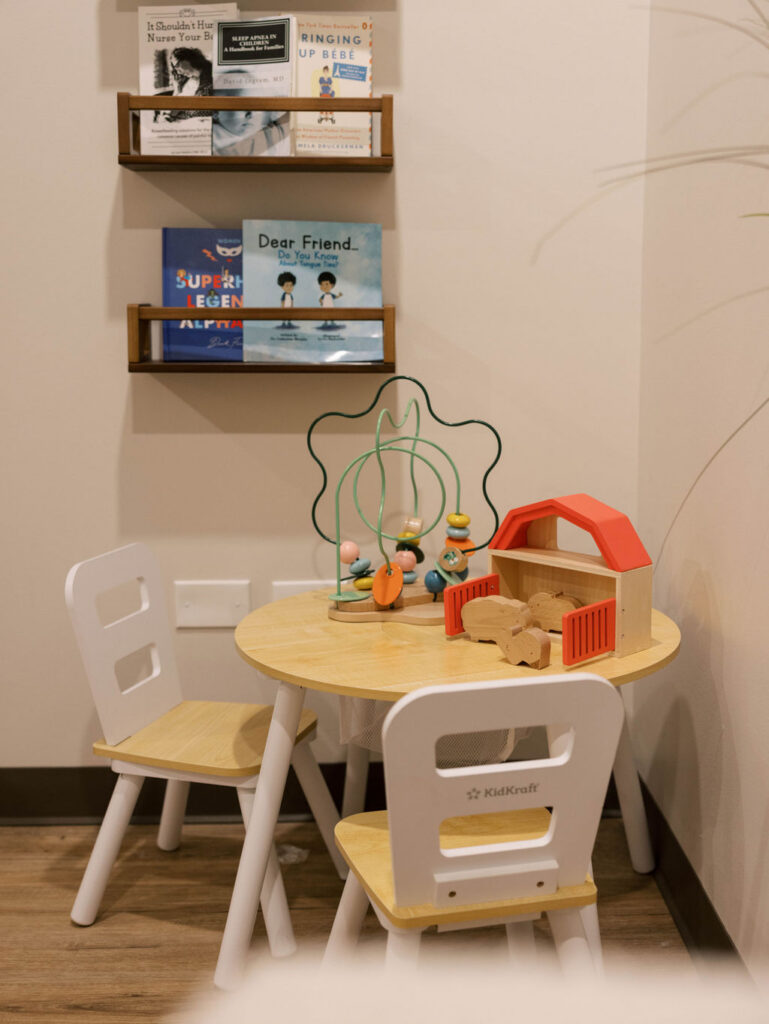
If you’re picturing your child sitting still for an hour doing tongue exercises — relax.
In-office sessions run 20 to 30 minutes with a trained therapist. The exercises look more like games than drills, especially for kids ages 4 to 10. Blowing up a balloon with only nose breathing. Holding a small object between the lips. Sticking the tongue to the roof of the mouth while humming. That kind of thing.
What a typical session includes:
- A quick check-in on the week’s home practice
- 2–3 new exercises introduced with demos
- Practice together, with the therapist coaching technique
- A home practice plan, usually 5–10 minutes a day
- A simple tracker so kids feel the progress
Parents sit in for the first few minutes so you know how to cue at home. Most treatment plans run 3 to 6 months with weekly or biweekly visits. Some families spread visits further apart once the basics are solid.
You’re probably wondering if your kid will actually cooperate. Most do. The exercises are short, the therapist keeps it moving, and kids respond well to visible progress — they can feel the difference when they do it right.
Results Show Up in Breathing, Sleep, and Facial Growth Over Months
Change doesn’t show up in week one. It shows up in the month-to-month.
Weeks 1–4: better lip seal at rest, less drooling, early tongue-to-palate posture, first signs of nasal breathing at rest.
Weeks 4–12: nasal breathing becomes the default, snoring decreases, sleep deepens. Teachers and family start noticing.
Months 3–6: facial growth gets the guidance it needs, chewing improves, speech clarity often sharpens, bedwetting and dark circles often ease.
Parents of kids at Devinny Elementary and Foothills Elementary frequently report changes teachers notice first — focus, posture, less daytime tiredness, better mood after recess. Kids don’t always connect the dots themselves, but the people around them do.
Therapy often runs in parallel with airway orthodontics — HealthyStart, Myobrace, or expansion appliances. The combination typically beats either one alone. The tongue guides the arch; the appliance widens the space; the tongue posture holds the change.
What to realistically expect:
- Steady progress, not dramatic overnight change
- Some weeks of plateau where nothing seems to shift — that’s normal
- Improvements parents notice more than kids do
- A noticeable difference comparing month 1 to month 4
If you’re still figuring out whether your child needs a release at all, our guide on tongue tie vs lip tie for Wheat Ridge parents walks through the signs.
Central Lakewood Parents Can Fit Therapy Around the School Day
The office sits at 3900 S Wadsworth Blvd in south Lakewood — a short drive from most central neighborhoods.
From central Lakewood (Belmar or the Lakewood Cultural Center area): Wadsworth Boulevard south, about 10 minutes.
From Green Mountain: south on Kipling, east on Hampden to Wadsworth, about 12 to 15 minutes.
From Bear Creek: Wadsworth Boulevard north, about 5 to 10 minutes.
Morning sessions work well before school drop-off. Mid-day sessions fit homeschool families, charter schedules, and kids at Addenbrooke Classical Academy or Dennison Elementary. Monday sessions can run until 5 PM, which helps working parents catch appointments after pickup.
Parking is free in the surface lot. The office is on the 6th floor, Suite 625 — elevator straight from the ground floor.
The drive is worth the trip. Finding myofunctional therapy coordinated with tongue tie release, airway orthodontics, and sleep-breathing evaluation under one roof is hard to do in Lakewood — and that coordination is what makes the treatment actually stick.
Frequently Asked Questions
How soon after the tongue tie release should therapy start?
Most children start myofunctional therapy within 1 to 4 weeks after the release, once the healing site is stable. Your provider will confirm the timing at your follow-up visit.
How long will my child need therapy?
Most treatment plans run 3 to 6 months with weekly or biweekly in-office sessions plus 5 to 10 minutes of daily home practice. Timelines depend on your child’s age, how ingrained the old patterns are, and how consistent daily practice is.
Can my child do therapy if we didn’t get the release done here?
Yes. We accept children who had a release elsewhere and need post-release therapy support. If your current provider doesn’t offer therapy, a handoff is straightforward.
Will my child actually cooperate with daily exercises?
Most do — especially when the exercises feel like games. The therapist builds age-appropriate routines and checks compliance weekly, so we catch drift early and adjust. A little resistance is normal; a full refusal usually means the exercises need adjusting.
How does therapy fit with braces or HealthyStart?
Myofunctional therapy complements airway orthodontics, HealthyStart, and Myobrace. The combined approach usually speeds results because the tongue stops fighting the appliance and starts supporting it.
What if my child is still recovering from the release itself?
That’s okay — we often wait 2 to 4 weeks post-release to start therapy. Your provider will signal when the healing site is ready.
Is the Lakewood office accessible for Green Mountain or Bear Creek families after school?
Yes. Afternoon slots are available Monday through Thursday, and parking is free with elevator access to Suite 625 on the sixth floor.
Will therapy help with bedwetting or mouth breathing too?
Often, yes. Tongue posture affects sleep quality, and improved sleep can reduce mouth breathing and bedwetting in many children. Results vary, but the changes are usually noticeable by months 3 to 6.

