



You’ve worn the nightguard. You’ve tried the massages. Maybe the muscle relaxers. Maybe even the chiropractor in Harvey Park your neighbor swears by. And the jaw pain just keeps coming back.
That’s the pattern we hear almost every week from adults in Harvey Park, Barnum, and Westwood.
Most TMJ treatment stops at the joint. It doesn’t ask why the joint is overworking in the first place. This guide explains how tongue position and jaw strain are connected — and what adult tongue tie treatment actually looks like. If you’re searching for answers to adult tongue tie TMJ pain West Denver Colorado providers haven’t connected, this walks through the full picture.
Our Lakewood office is a short drive east along US-6 or Alameda, with evening availability Monday. A consult starts with airway imaging and a functional assessment — not just a jaw exam.
The Tongue and the Jaw Joint Work Together Every Time You Swallow
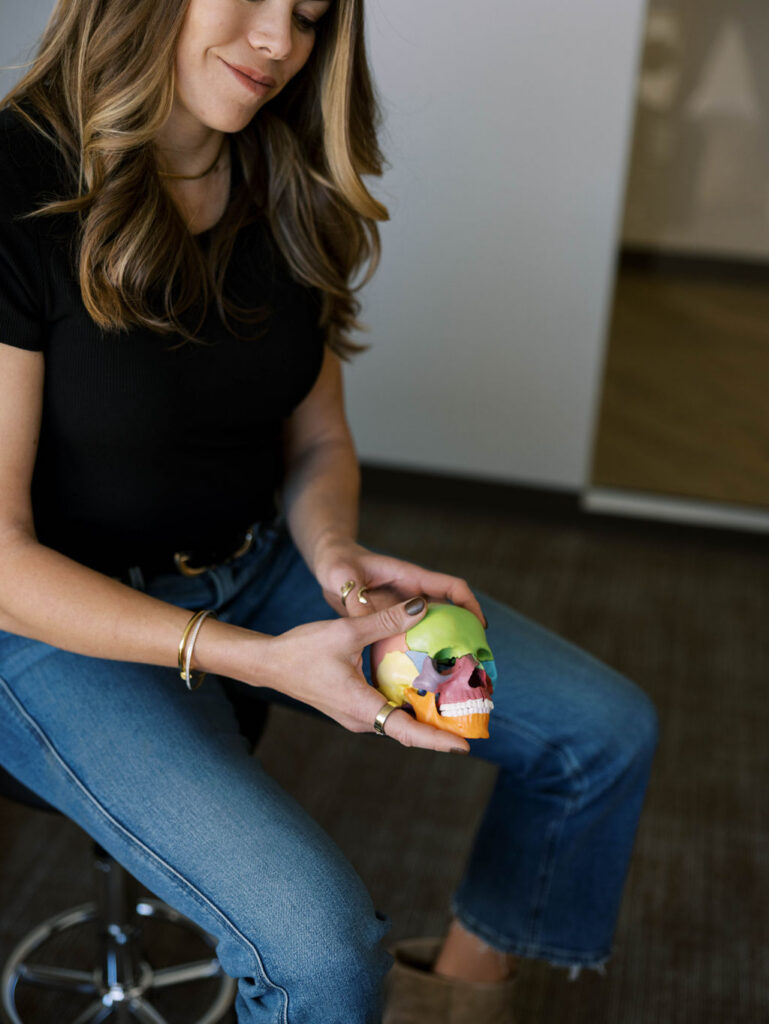
Most adults never think about their tongue. It does its job quietly, thousands of times a day.
You swallow more than 1,000 times in a 24-hour cycle. Every single swallow, the tongue presses up against the roof of the mouth. When the tongue can’t reach the palate — because a tight band of tissue underneath is holding it down — other muscles step in to finish the job.
Those muscles are your jaw, your cheeks, your floor of mouth, and your neck. They weren’t built to handle all that compensation. They get tight. They stay tight. They refer pain into the joint, the ear, the temple, and the back of the neck.
Here’s the chain most adults never hear explained:
- Restricted tongue → low resting tongue posture
- Low tongue posture → mouth slightly open at rest, reduced nasal breathing
- Compensation from jaw and neck → chronic tension
- Chronic tension → TMJ strain, clenching, headaches, neck pain
A lot of Harvey Park adults — especially folks living in those mid-century Cliff May homes, typically in their thirties and forties — develop this pattern silently over decades. There’s no single injury to blame. It’s just wear.
A Restricted Tongue Often Sits Behind Chronic TMJ Pain in Adults
Temporomandibular disorders affect around 10–15% of adults, according to population data cited by the American Academy of Family Physicians. That’s millions of people. Most never get a real answer about root cause.
So when you’ve been through the standard treatments and the pain keeps coming back, it’s worth asking a different question: is something upstream driving this?
Signs a tongue tie may be driving your TMJ pain:
- Tight, short floor of the mouth
- Narrow palate (upper teeth feel crowded or have always been)
- Clenching during the day, not just at night
- Tongue that can’t comfortably reach the roof of your mouth
- Reflexive mouth breathing, especially when focused or sleeping
Signs the jaw is compensating hard:
- One-sided clicking or popping
- Waking with a sore jaw every morning
- Chronic neck or shoulder tension that won’t release
- Headaches that start at the temples and travel back
- Ear fullness or ringing with no ear infection
Adults often describe cycling through providers along Federal Boulevard in Westwood and Barnum — general dentists, PTs, chiropractors, maybe a neurologist — without anyone mapping the full picture. A CBCT scan changes that. It shows tongue space, jaw alignment, and airway width in one image. Suddenly the pattern is visible.
Adult Laser Release Is Done Awake and Takes Under an Hour
This is the part most adults picture as jaw surgery. It isn’t.
Local numbing only. You sit upright in the chair, awake the whole time. The soft-tissue laser releases the tight band in under a minute of active cutting. Minimal bleeding. No stitches. Most adults eat normally the same day and are back at work the same afternoon — or the next morning if they schedule late in the day.
What the visit looks like:
- A CBCT airway scan and functional exam
- Topical numbing, then local anesthetic
- The laser release (quick, precise, sealed as it cuts)
- Post-release instructions and a short demo of the stretches
- A few minutes of comfort time before you head out
Discomfort after the release is usually mild — comparable to a mouth ulcer — and managed with over-the-counter options. Most adults describe it as “less painful than I expected.”
If you’re picturing something invasive — a hospital visit, general anesthesia, wired jaw — this procedure is nothing like that.
Myofunctional Therapy After Release Retrains the Jaw Pattern
The release opens the door. The jaw pattern is what has to change for pain to actually quit.
Decades of compensation don’t undo themselves just because the tongue can now move. Your jaw muscles have learned one way to function, and they’ll keep doing it unless you give them new signals. That’s what myofunctional therapy does.
What therapy involves:
- Short in-office sessions, usually weekly or biweekly
- Targeted exercises for tongue posture, swallow pattern, and lip seal
- Home practice of 5–10 minutes per day
- Progress tracked over 6–12 weeks
Many adults report TMJ symptoms easing over that 6–12 week window. Tongue posture during sleep also shifts, which often reduces grinding and snoring as a side benefit — Cleveland Clinic notes that coordinated conservative treatment tends to produce better long-term results than any single intervention alone.
Skip therapy after an adult release and the jaw usually reverts to its old compensation pattern within a few months. The release becomes a procedure you had, not a problem you solved.
A lot of West Denver adults already have active routines — Bear Creek Trail runs in the morning, biking the South Raleigh Street lane, yoga at the gym. Myofunctional exercises fold in well. They’re short, they’re quiet, and they travel.
West Denver Commute Patterns Make the Lakewood Office an Easy Stop
The office sits at 3900 S Wadsworth Blvd in south Lakewood — a straightforward hop from most West Denver neighborhoods.
From Harvey Park: west on Hampden Avenue, then north on Wadsworth. About 10 to 15 minutes.
From Barnum or Westwood: Alameda or US-6 west, then south on Wadsworth. About 15 to 20 minutes.
From elsewhere in West Denver: the W Line connects at Federal Center or Lakewood-Wadsworth stations for transit-friendly visits.
Parking is free in the surface lot. The office is on the 6th floor, Suite 625 — elevator directly from ground level. Monday appointments run until 5 PM, which matters for West Denver adults catching us after a work day.
The honest truth: the drive is worth the trip. No West Denver general dentist connects TMJ pain to adult tongue tie with CBCT imaging and myofunctional therapy under one roof. That’s the combination that actually moves the needle on chronic pain.
Frequently Asked Questions
How is adult tongue tie different from the version people treat in babies?
In adults, the restriction has shaped muscle patterns, posture, and jaw alignment for decades, so release alone rarely solves the problem. Therapy is paired with the release to undo those compensations. Our adult tongue-tie release page walks through what the visit involves, from assessment through myofunctional therapy.
How long is the drive from Harvey Park or Westwood?
The Lakewood office is about 10 to 20 minutes from most West Denver neighborhoods via US-6, Alameda, or Hampden to Wadsworth. Evening traffic on Hampden can add a few minutes, so scheduling earlier in the day helps if you’re coming from Westwood.
Will insurance cover adult tongue tie treatment?
Coverage varies. Our team can provide a coded estimate for you to submit to your insurer, though most adult airway treatment is fee-for-service. HSAs and FSAs are accepted.
Can this really help my TMJ if I’ve already tried nightguards?
Many adults with stubborn TMJ pain have never had their tongue posture or airway assessed. A nightguard protects teeth from grinding but doesn’t address why you’re grinding in the first place. If the root cause is tongue restriction driving jaw compensation, a different approach is needed.
Do I need myofunctional therapy, or just the release?
For adults, therapy is strongly recommended. The release alone rarely resolves long-standing jaw patterns. Therapy is what makes the release stick.
I’ve had years of jaw pain. Will the release itself hurt more because of that?
Not the release, but the adjustment can take longer. Local numbing handles the procedure regardless of how much tension you’ve been carrying. What differs is afterward: someone with decades of clenching and jaw compensation often needs more time to settle into new tongue movement than someone whose restriction was mostly affecting speech. The soreness is comparable either way. See the day-by-day recovery timeline for what to expect in the first two weeks.
How quickly will I feel relief?
Some adults notice early changes, less morning jaw soreness and easier swallowing, within the first few weeks. Broader TMJ relief typically unfolds over 6 to 12 weeks of consistent therapy. Timing depends on how long the pattern has been in place.
Will this help my snoring too?
Often, yes. Tongue posture during sleep affects airway position, and many adults report quieter sleep as a side benefit of tongue tie treatment and myofunctional therapy. Our West Denver article on adult tongue tie treatment for TMJ, sleep, and breathing goes deeper on the sleep piece.
Is there parking close to the office for someone coming from Barnum after work?
Yes. 3900 S Wadsworth Blvd has free surface parking with evening availability and direct elevator access to Suite 625.

