


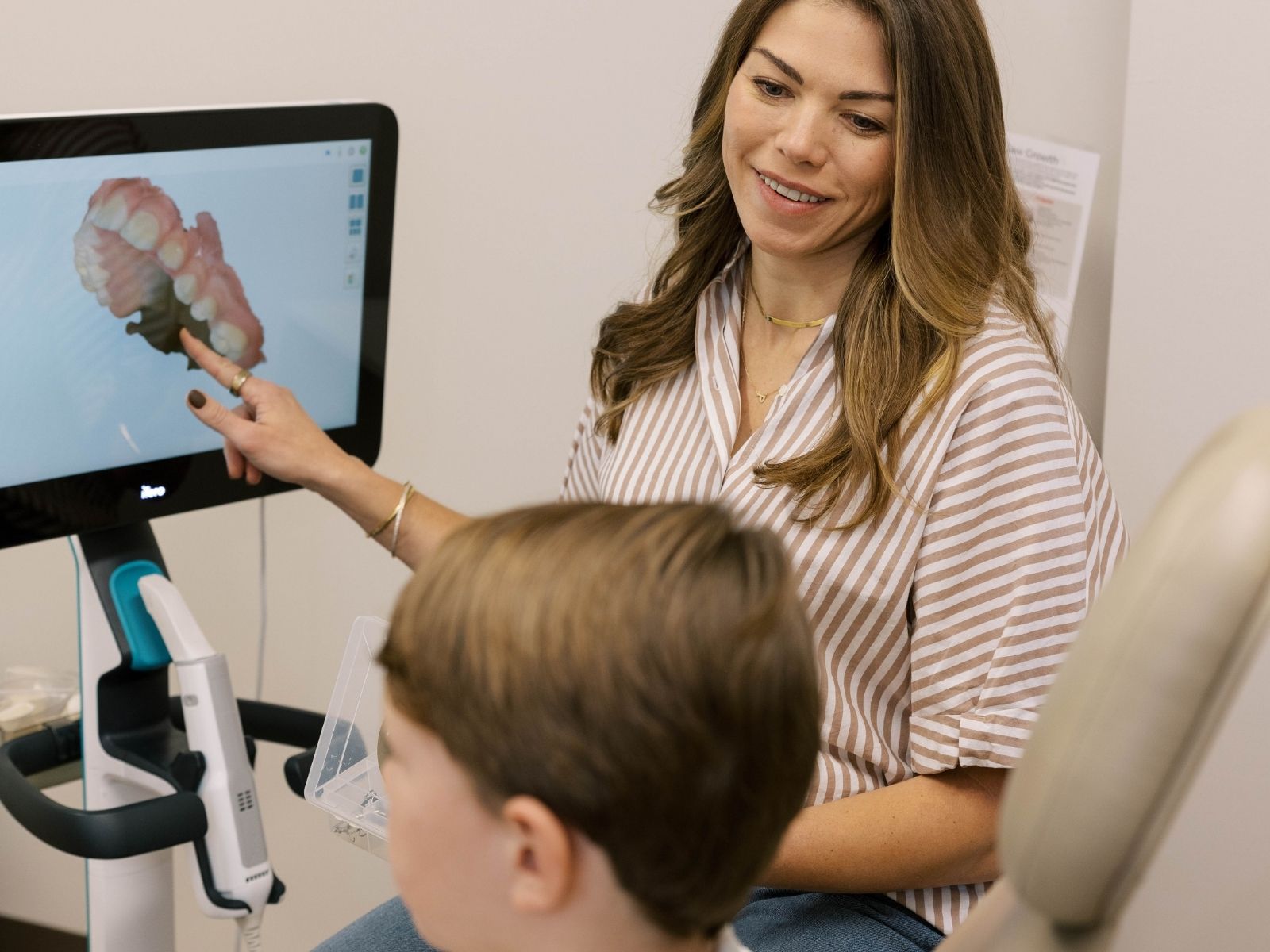


If you’ve been trying to figure out whether your child has a tongue tie, a lip tie, or both — you’re not alone. Most Wheat Ridge parents who find this page have already heard conflicting things from their pediatrician, their dentist, and a few well-meaning people in parenting groups. And they’re still not sure what’s actually going on.
That confusion makes sense. Tongue ties and lip ties are different restrictions. They affect different things. And most general providers don’t have the tools — or the training — to tell you which one your child has, or how it’s affecting their breathing, sleep, and development.
This page explains the difference between the two. It covers how each restriction shows up in children, how laser release works for both, and what to expect after treatment. It answers the question Wheat Ridge families are searching for: what is the difference between tongue tie vs lip tie in children, and what should you actually do about it?
Our office at 3900 S Wadsworth Blvd, Suite 625 in Lakewood is about 10 minutes south of Wheat Ridge — straight down Wadsworth. We serve children from infants through their early teens. If you’re ready to stop guessing and get a real airway evaluation, you can schedule at (720) 783-5424 or at untetheredairwayhealthcenter.com.
Tongue Ties and Lip Ties Are Different Problems With Different Effects on Children
A tongue tie — also called ankyloglossia — means the tissue under your child’s tongue is too short or too tight. It limits how far and how freely the tongue can move. A lip tie means the tissue connecting the upper lip to the gum is too restrictive. It limits how the upper lip lifts and flanges during eating and speaking.
These are two separate restrictions. They affect different movements and show up differently in children. Some kids have one or the other. And some children have both at the same time — what’s called a combined restriction.
Neither condition resolves on its own as a child grows. The tissue doesn’t loosen with age. If anything, the effects become more noticeable as demands on speech, sleep, and breathing increase.
A narrow palate or crowded front teeth can signal that both restrictions are present. Wheat Ridge pediatricians often miss this because routine exams don’t include tongue mobility testing in any meaningful depth.
The Signs That Tell Wheat Ridge Parents Which Restriction Their Child Has
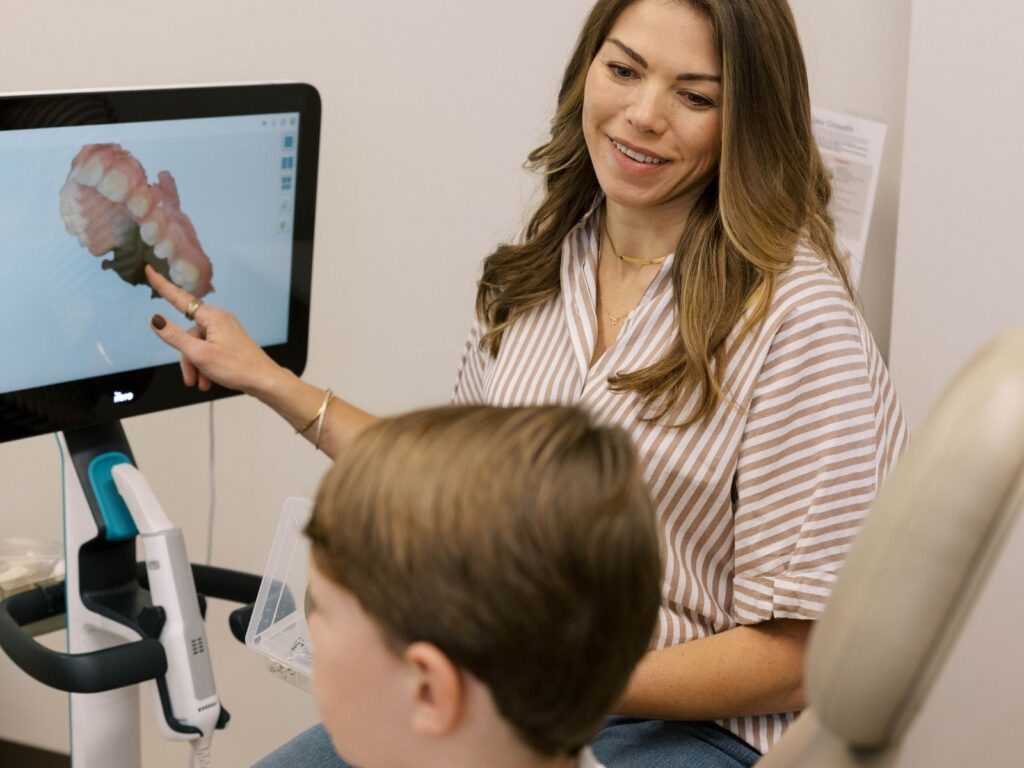
Most families who find their way to our Lakewood office have already been told something like “it looks fine” — by a pediatrician, a general dentist, maybe both. But they still know something’s off. Trust that.
Here’s how the two restrictions tend to show up differently:
Tongue tie signs in children:
- Speech delays or difficulty with specific sounds (R, L, TH, K, G)
- Messy eating or trouble managing food in the mouth
- Teeth grinding at night
- Snoring or mouth breathing during sleep
- Crowded front teeth
- Daytime tiredness and poor focus
Lip tie signs in children:
- A visible gap between the upper front teeth
- Food getting trapped at the gum line after meals
- Trouble forming a tight lip seal at rest
- Upper lip that doesn’t move freely when speaking or eating
Signs that often point to both:
- Narrow upper palate
- Chronic mouth breathing
- Poor sleep quality — dark circles under the eyes in the morning
- Restless nights or sleep terrors
Many Wheat Ridge families first notice something during elementary school years when speech becomes more prominent socially. Wheat Ridge’s median resident age is over 40, which means a lot of parents in this area have school-age kids who never had an early evaluation. The window for easy intervention is still open — but it doesn’t stay open forever.
The American Academy of Pediatric Dentistry recommends early evaluation for children showing signs of oral restriction, particularly when speech or sleep are affected. A specialist evaluation at an airway-focused practice uses different criteria than a general exam — tongue mobility testing, palate width assessment, and airway screening together give a much fuller picture.
Laser Release Is the Standard for Both Tongue Ties and Lip Ties in Children
When a release is needed, laser frenectomy is the most precise and gentle option available for children. The soft tissue laser removes the restrictive tissue with minimal bleeding and no stitches. Healing is faster than older scissor-based approaches, and children tolerate the procedure well.
Tongue tie release is performed on the underside of the tongue. Lip tie release frees the upper lip attachment just above the front teeth. Both can be done in the same appointment in most cases — which means one visit, not two.
For Wheat Ridge families, that’s a single drive down Wadsworth to our office on S Wadsworth Blvd in Lakewood. The procedure itself is brief. Most children return to normal activity the same day.
What makes an airway-focused evaluation different from a general pediatric dental visit is the broader lens. We’re not just looking at whether a tie exists — we’re assessing how the restriction affects your child’s breathing, sleep posture, and development. That’s a different question, and it leads to a more complete treatment plan.
Myofunctional therapy almost always begins alongside or after laser release. The release frees the restriction — therapy retrains the movement patterns the tongue has developed around it.
What Wheat Ridge Families Can Expect After Tongue Tie or Lip Tie Release

The release itself is one appointment. But the full journey takes months — and understanding that upfront makes the process much less frustrating.
Here’s the typical arc:
- Weeks 1–2: Tongue mobility increases. Eating speed often improves quickly. Early changes in mouth posture at rest.
- Weeks 3–6: Sleep quality starts to shift. Snoring may decrease. Mouth begins to close more naturally.
- Months 2–4: Myofunctional therapy builds lasting muscle memory for correct tongue posture and swallowing.
- Months 4–6: School performance and focus often improve as sleep quality stabilizes. Teachers frequently notice the change before parents do.
Children who present with a narrow palate or crowded teeth may benefit from additional airway orthodontic support alongside therapy. That’s evaluated at the initial consultation — not assumed upfront.
Home stretches after laser release are important. We teach these at the appointment, and they take about five minutes a day. They’re a big part of why results hold.
Wheat Ridge families managing school pickups and commutes tend to appreciate that the at-home component is simple and short. Sessions at our office are spaced to fit around school schedules. Monday hours run until 5 PM, which allows after-school appointments for families coming south down the Wadsworth corridor.
If your child is also dealing with speech delays alongside the physical restriction, our article on children’s tongue-tie release for speech delays goes deeper on how laser release and speech therapy work together.
Getting to Our Lakewood Office From Wheat Ridge and Nearby Neighborhoods
Our office is at 3900 S Wadsworth Blvd, Suite 625, Lakewood, CO 80235 — just south of the W Hampden Ave (Hwy 285) intersection.
From most parts of Wheat Ridge, the drive is about 5 miles and takes roughly 10 minutes with normal traffic. No highway required — just Wadsworth heading south, straight to the building.
- From central Wheat Ridge: Take Wadsworth Blvd south — it’s the same road the office is on.
- From East Wheat Ridge: Take W 38th Street west to Wadsworth, then head south.
- From Arvada: Take Kipling south to W 6th Ave (US-6), then south to Wadsworth.
Parking is available in the building lot — no permit or parking structure needed. RTD Bus 76 runs the Wadsworth corridor and connects Wheat Ridge to this part of Lakewood for families who prefer not to drive.
We’re open Monday through Thursday, with Monday hours running until 5 PM. Fridays are by appointment only.
Phone: (720) 783-5424 Website: untetheredairwayhealthcenter.com
Frequently Asked Questions: Tongue Tie vs. Lip Tie in Children Near Wheat Ridge
What should I expect after my child’s tongue tie or lip tie is released? Early changes like improved eating and mouth posture often appear within the first two weeks. Sleep and focus improvements build over two to four months, especially when myofunctional therapy is part of the plan. For a detailed week-by-week look at the recovery arc, see our guide on what families experience after tongue tie release near Green Mountain and Bear Creek.
How far is the Lakewood office from Wheat Ridge? About 5 miles — roughly 10 minutes south on Wadsworth Blvd with normal traffic. No highway driving needed from most Wheat Ridge neighborhoods.
My Wheat Ridge pediatrician said the tongue tie isn’t a problem. Should I still get an evaluation? Yes. General pediatricians are not trained to assess tongue mobility depth, and routine exams don’t include the kind of functional testing an airway specialist uses. A specialist evaluation looks at how the restriction affects movement, breathing, and sleep — not just whether the tissue is visible.
Can both a tongue tie and lip tie be released in the same appointment? Yes — in most cases, both restrictions can be addressed in a single laser appointment. One visit, not two.
What makes laser release different from what my Wheat Ridge dentist described? Laser is more precise, causes less trauma to surrounding tissue, and requires no stitches. Healing is faster, and the procedure is better tolerated by children of all ages compared to older scissor-based techniques.
My child is 8 and still mouth breathes. Is it too late to treat a tongue tie? No. Children’s airway tissue is still adaptable, and older children benefit significantly from release combined with myofunctional therapy. Earlier intervention is easier, but it’s not the only window. Our children’s tongue-tie release page explains what treatment looks like for kids at different ages.
My child’s speech therapist thinks a tongue tie might be slowing their progress. What’s the connection? A tight frenulum physically prevents the tongue from reaching the positions needed to form certain sounds — R, L, TH, and others. Speech therapy builds the right patterns, but if the tongue can’t get there, progress stalls. Laser release addresses the physical restriction. For a detailed look at how this works, see our article on tongue-tie release and speech delays.
How many appointments will my child need if they have both a tongue tie and lip tie? The evaluation is first. Most releases are a single visit. Myofunctional therapy follow-up typically runs several months on a schedule built around your family’s routine — not the other way around.

