


More than a feeding problem
Children’s Tongue-Tie Release in Brookfield, WI
In older kids a tight tongue shows up as slow eating, unclear speech, mouth breathing, snoring, and tired mornings, often tracing back to where the tongue rests and how your child breathes.
What the symptoms are really saying
Tongue-Tie Shows Up as More Than Feeding Struggles
Maybe the feeding struggles ended years ago. Your child eats now, so everyone moved on, but dinner still takes forever and you’re still cutting food into tiny pieces long after their friends stopped needing it. Or the call comes from school: your child seems tired, can’t focus, and melts down by afternoon, and you may have been told the tie would stretch on its own. Here’s what’s going on underneath. At rest, the tongue should sit up against the roof of the mouth, and that steady, gentle pressure helps the upper jaw grow wide. When a tight band of tissue under the tongue holds it down, the tongue rests low instead, which can lead to a narrower palate, which leaves less room for air to move through the nose, so your child may start breathing through the mouth and sleep gets lighter and choppier. Signs that may point back to a restricted tongue include slow or messy eating, trouble with L, R, TH, or S sounds, a mouth hanging open at rest, snoring or restless sleep, bedwetting past the usual age, night grinding, dark circles with groggy mornings, and headaches right after waking.

No single sign proves a tongue-tie, since plenty of kids have one of these for a different reason, but when several show up together it’s worth looking at how your child’s tongue moves and how they breathe. That’s why we don’t judge a tongue-tie by how the tissue looks: a short band that moves well may need nothing at all, while a band that looks mild can still pin the tongue low. We look for the reason behind the symptoms first, and our in-house CBCT 3D imaging lets us see the airway clearly. Releasing the tie is only one step, though, because the tongue also has to learn a new resting spot after years in the wrong one, which is why our myofunctional therapy, exercises that retrain the tongue and mouth muscles, happens here rather than through a referral. We also work alongside speech-language pathologists, occupational therapists, and bodyworkers throughout Southeast Wisconsin, so if your child already sees a therapist closer to home in Waukesha, New Berlin, or Wauwatosa, that care can stay part of the picture.
When a Release Isn’t Needed
Maybe a friend’s child had a release and now you’re second-guessing everything, or someone online said every tie should be clipped. That pressure is real, but a release isn’t the answer to every hard meal or rough night, and some signs that look like a tie come from somewhere else. Releasing the tissue won’t fix mouth breathing that only happens with a cold or allergy flare, snoring linked to large tonsils or adenoids (which may call for an ENT first), speech sounds still on track for your child’s age (R and TH often come in later), picky eating driven by texture or smell (often a sensory issue an occupational therapist can help with), or a tongue that already lifts, sticks out, and moves side to side with ease. Sometimes a tie is part of the picture but not the only part: a child can have a mild tie and also have allergies keeping the nose stuffed, in which case clearing the nose may come first.

Timing matters too. The tongue has to learn a new resting spot after a release, which takes daily practice at home, so if your family is in the middle of a move, a new baby, or a packed season, waiting a bit is a fair call. Your child’s readiness counts as well, since an older child who is scared or won’t do the exercises may not get much from a release yet, and a few months of building trust can make a real difference. None of these are failures; they’re just a different order of steps. “Not now” might mean treating allergies, seeing an ENT, or giving speech a little more time, and hearing “not right now” is a real answer, not a brush-off. You’ve likely heard “wait and see” before with nothing behind it, and this is different: waiting with a reason, and a clear idea of what to watch for, is a plan, while waiting with no answers is what leaves families stuck. Families from Elm Grove, Pewaukee, and across Waukesha County often arrive after years of mixed answers, and we see tongue posture as a real part of Brookfield children’s health, not a side note to skip at a checkup.

What the Evaluation Looks At
Not a Promise of a Release
An evaluation is a careful look at whether a tight tongue or lip is part of why your child eats, talks, breathes, or sleeps the way they do. No single question decides it, and the breathing questions are the hardest to answer by looking in a mouth, which is where our in-house CBCT imaging and home sleep testing come in.
- How high the tongue lifts, how far it sticks out, and how it moves side to side
- Where the tongue rests, and whether the lips close easily or hang apart
- Nose versus mouth breathing, awake and asleep, and the width of the palate
- Whether something else, like allergies or large tonsils, plays a bigger role
Why Families Ask About Laser
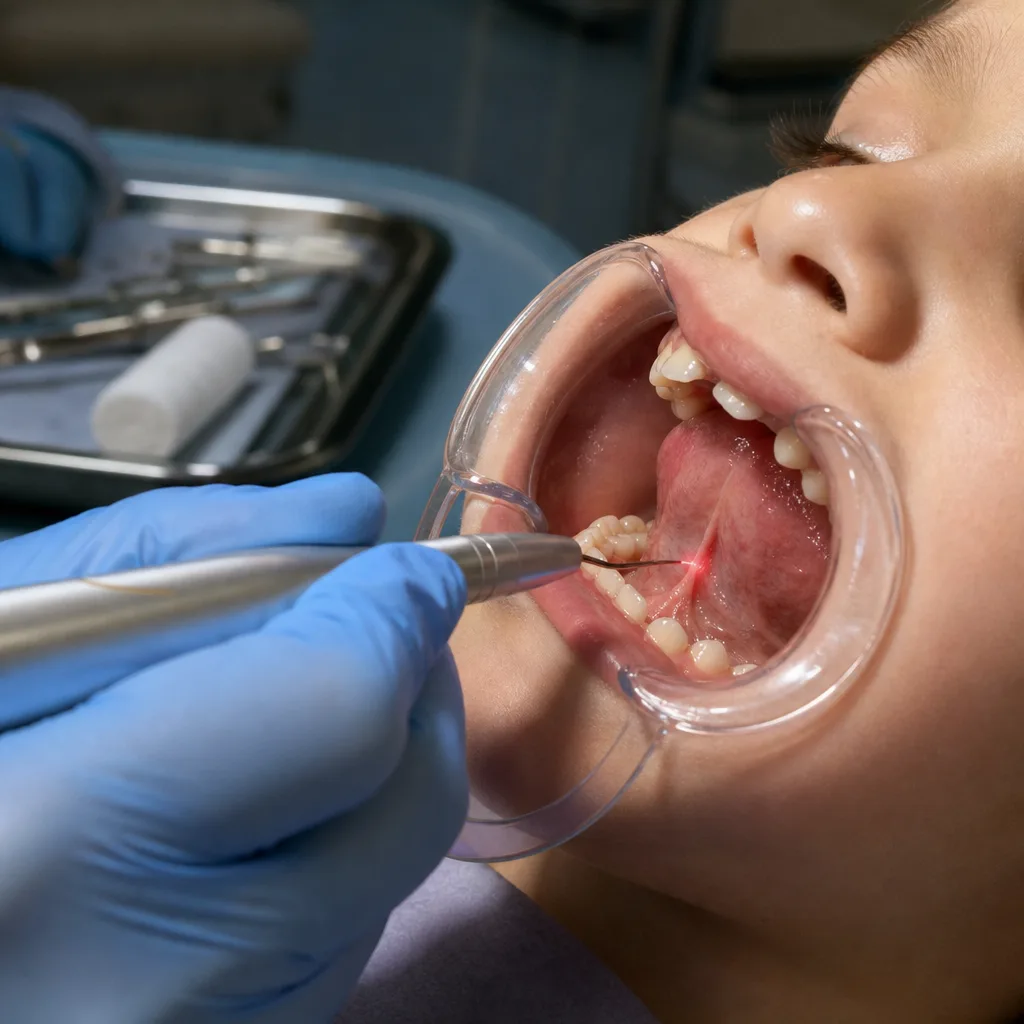
It’s late and you’re searching again: one video shows a quick snip with scissors, another shows a laser, a friend swears by one and another parent by the other. A frenectomy releases the tight band of tissue under the tongue or upper lip, and providers can do it with a few tools, each with its place. Scissors are a fast snip often used for young babies with thin ties near the tip, but may not reach thicker tissue farther back. Frenuloplasty cuts and reshapes the tissue and closes it with stitches, sometimes used for thicker ties. A laser uses a focused beam of light, and laser energy tends to seal tiny blood vessels as it works, which is a big reason parents ask about it. Most families who ask about laser aren’t chasing a trend; they want the gentlest path for a child who’s already been poked, checked, and told to wait. That’s why we use laser frenectomy for a gentle release, with a team trained in laser release for infants, children, and adults, covering both tongue and lip ties.
The honest part: the tool matters less than two other things. First, was the tight tissue fully released, or just part of it? Second, does the tongue get help learning its new resting spot afterward? A partial release can leave the tongue pinned low even if the band looks different, so the palate still lacks that steady upward push, the nose still has less room for air, and the snoring, bedwetting, and groggy mornings may stay right where they were. A full release is a start, not a finish, since the tongue still has to be retrained after years in the wrong spot, which is why we don’t treat the laser as the whole answer. If your child had a clip as a baby and things didn’t change much, that isn’t your fault and doesn’t mean nothing can help; tell us what was done and what you’ve noticed since, and it helps us see whether tight tissue remains or whether something else is driving the symptoms. So ask about the method, but also ask how the provider decides what to release, how far, and what comes next, because those answers tell you more than the name of the tool does.
See more children’s care from Untethered Airway Health Center
Common Questions About Children’s Tongue-Tie Release in Brookfield
How safe is laser tongue-tie release for children?
Laser frenectomy provides exceptional safety and precision, with minimal bleeding and faster healing than scissors or scalpel methods. The procedure completes in under 10 minutes at our Brookfield clinic, with children typically resuming normal activities immediately. For a closer look at how laser treatment compares to a traditional clip, and the real risks worth knowing before you book, see our guide on weighing the risks and choosing a provider.
At what age should a tongue-tie be treated?
Children benefit from treatment at any age, though earlier intervention typically yields better outcomes. We evaluate and treat kids from toddlers through teenagers, and age alone doesn’t rule your child out; what matters more is whether the tie is affecting eating, speech, breathing, or sleep. Early release can help prevent speech delays and feeding difficulties. If you’re wondering whether your older child might still show signs worth checking, see our guide on signs of tongue-tie in children.
Is the procedure painful?
Topical anesthetic applied before treatment keeps children comfortable during the brief procedure. Most experience minimal discomfort, managed with children’s Tylenol if needed. Laser technology means reduced swelling and faster recovery than older methods.
How long is the recovery process?
Children return to regular activities the same day, including school. We provide detailed aftercare instructions and exercises that prevent reattachment. Complete healing occurs within two weeks, though functional improvements often appear within days. For the full path from release to muscle training, see our guide on tongue-tie or lip-tie in children.
What results can we expect after a release?
Parents report enhanced speech clarity, comfortable eating, and improved sleep within weeks following treatment. Combined with prescribed exercises, families see good long-term outcomes in oral function, breathing, and facial development. Many families also notice improvements in bedwetting and focus, a connection we cover in our tongue-tie and sleep problems guide.
Will my child need speech or other therapy after the release?
Many children do, because releasing the tissue is only the first step. The tongue still needs to learn a new resting spot after years of sitting low, which is why myofunctional therapy happens in-house as part of the plan. If your child already works with a speech-language pathologist or occupational therapist in Waukesha, New Berlin, or Wauwatosa, that care can keep going alongside the release.
Can allergies or large tonsils be mistaken for a tongue-tie?
Yes, a stuffy nose from allergies or enlarged tonsils and adenoids can cause mouth breathing and snoring that look like tongue-tie symptoms. In those cases, a tongue that lifts and moves freely points away from a restriction, and treating the allergy or seeing an ENT may be the better first step. That’s why we look at breathing as a whole picture, not just the band under the tongue.

Airway First
We look for the reason behind the symptoms using in-house 3D imaging, so a release is recommended only when it will actually help.
Gentle Laser
A precise laser release with in-house myofunctional therapy afterward, since a full release is a start, not a finish.
Investment
The total depends on what the plan includes. We explain each step, from evaluation to therapy, so nothing surprises you later.
Ready to Begin?
If the slow dinners, the unclear speech, and the restless nights keep adding up, an evaluation can tell you whether a tight tongue is part of the story. Call (414) 935-8460 or request an appointment online at our Brookfield office on Water Tower Blvd.

